Case study
MyHunt
One of the largest hunting social networks in the world, past a million downloads. I took it over, led its redesign, and kept shipping to a live community throughout.
- Role
- React Native developer, Mantro
- When
- Sep 2023 — 2025
- Platforms
- iOS · Android
- Highlight
- 1M+ downloads
- React Native
- Redux Toolkit
- Google Maps
- Mapbox
- EAS
- CircleCI
The brief
MyHunt is a hunting and game-area management app used across Europe, backed by hunting associations and, by the company’s own public figures, more than 700,000 hunters. By the time I joined it was long past a million downloads and had years of production code behind it.
That is a very different problem from a greenfield build. Everything I changed had to ship to an existing, active user base without breaking the workflows they relied on in the field — often with no signal, in the dark, on a cold morning. There was no window where the app could simply be down or wrong.
What I worked on
I took over the app and led a redesign to a modular architecture, breaking a large codebase into feature modules with clearer boundaries so that work on one area stopped rippling into unrelated ones.
Alongside the restructure I owned the map stack and the release pipelines, and kept a continuous stream of features going out to users while the underlying architecture changed beneath them.
Migrating the state layer from MobX to Redux Toolkit
The app’s state was managed with MobX, and I migrated it to Redux Toolkit. On an app this size that is not a rewrite you can do in one release — the two have to coexist while feature work continues, and each slice has to move without changing observable behaviour for the user.
The payoff is predictability. Explicit actions and a serialisable store make state transitions traceable, which matters a great deal in an app where a bug can mean a lost track log or a harvest entry that never saved.
Maps, offline, and the release pipeline
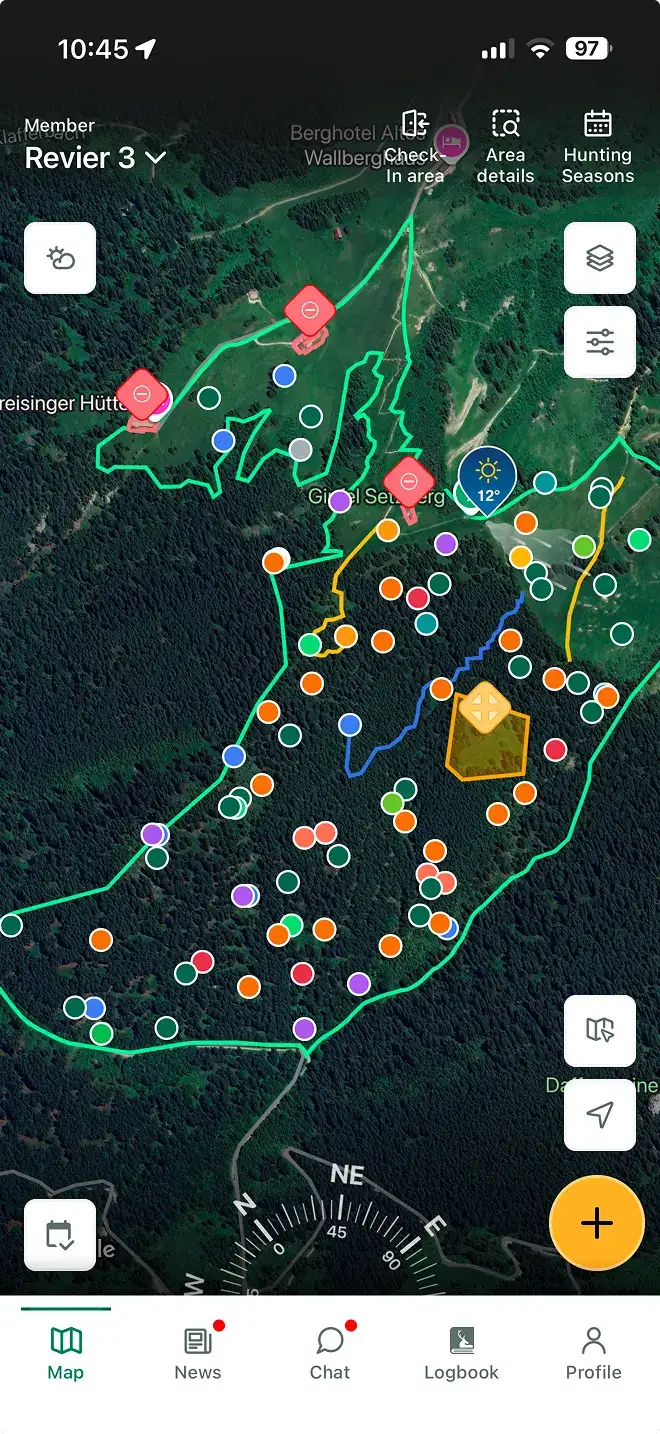
Maps are the core of the product rather than a feature bolted onto it: hunting areas, stands, sightings and harvests are all spatial, and much of the app is used with no connectivity at all. I owned that stack across Google Maps and Mapbox.
I also owned the release pipelines, running builds through EAS and CircleCI so that shipping to both stores was a repeatable process rather than a manual event.
Outcome
The app passed a million downloads and continued shipping features to a live community throughout the restructure — which, on a codebase of that age and reach, was the actual constraint worth optimising for.